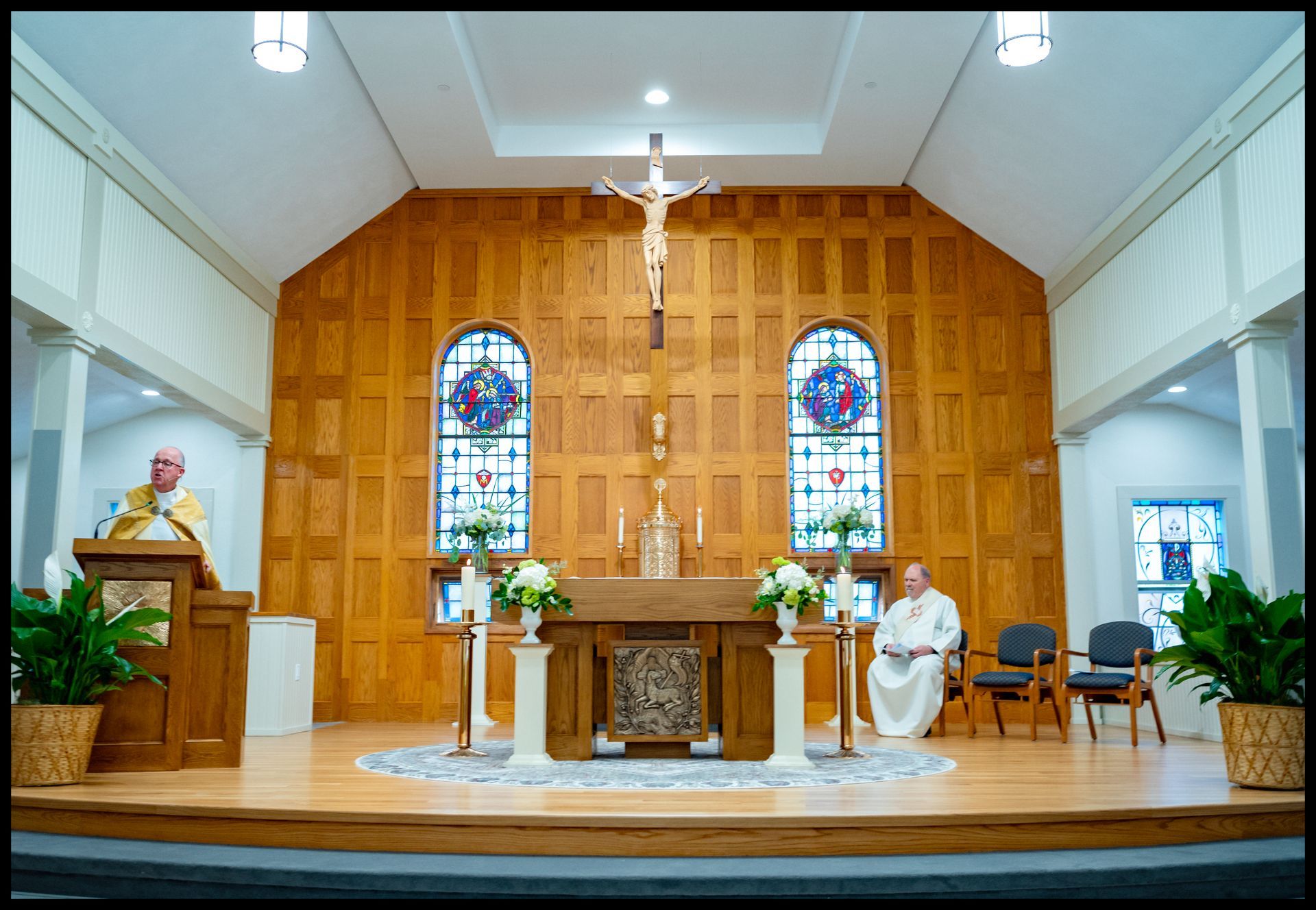
3rd Sunday of Lent Homily- From Hiding to Healing
3rd Sunday of Lent- Deacon Arthur LaChance
"From Hiding to Healing"
My friend and fellow deacon Dennis once asked me to accompany him on a late afternoon visit with an elderly man who lived alone.
Dennis had originally met the man through St. Vincent dePaul — and had discovered that the two of them shared much in common - a love for accounting, a deep love of music, and absolutely no skill what-so-ever with tools.
The man’s house was tidy but worn — and in the kitchen, the faucet over the stainless-steel sink dripped steadily. Dennis thought I might be able to fix it. I offered to, but he waved me off. “It’s been like that for years,” he said. “I’ve gotten used to the sound.” Then he added, almost as an afterthought, “You can get used to almost anything if you live with it long enough.”
“But,” I replied, “you don’t have to.”
And that seemed to open a flood gate.
As we sat at the table, he began telling us about his life — about mistakes he had never spoken aloud — about relationships that had quietly dried up — about a loneliness he wore like a coat he could not take off. “I suppose God knows all that anyway,” he said. “But I wouldn’t know where to begin.”
I wonder how often do we live with the drip of unresolved sin, regret, and longing — convincing ourselves that it’s just the way things are.
This is the third week in our homily series, “From Hiding to Healing.” The first week we stood with Adam and Eve in the garden and with Jesus in the desert. We talked about temptation and the subtle way sin begins—not always with rebellion, but with mistrust. When things begin to break inside us, our first instinct is to hide. And we named something essential for Lent: the first step toward mercy is honesty.
Last week we learned that trust must lead to movement. We cannot be transformed if we refuse to move. Confession does not trap us in who we have been; it reveals who we are called to be. It is not about being stuck in guilt; it is about being set in motion by grace.
Today we make a visit — not to a home, but to a well in Samaria. We go — not with St. Vincent de Paul — but with Jesus. We go at noon — in the heat of the day — and we meet a woman who has grown used to the drip.
She comes at noon because noon is when no one else is there. The other women come in the cool of the morning. She comes when the sun is high and unforgiving. She carries not just a water jar, but a history. Five husbands. The man she is with now is not her husband.
In her village she is defined by her past. She has learned to manage her shame by choosing isolation. It is easier to come alone than to endure the biting remarks, sideways glances.
And Jesus meets her exactly there. Not in the synagogue. Not after she has cleaned up her life. Not once she had found the right words. He meets her where she is, not where she pretends to be.
That is always how Christ works. He asks her for a drink. It is such a simple request, but it opens everything. He begins not with accusation but with relationship. He allows Himself to be vulnerable before He ever speaks of her sin.
He speaks of living water, of a gift that will become a spring within her. And then, gently, He says, “Go, call your husband.” He already knows. The text makes that clear. He names her story without contempt, without sarcasm, without raising His voice. “You are right in saying, ‘I do not have a husband.’”
There is no humiliation here. There is truth, and there is mercy. She is known fully — and loved still.
That is the heart of Reconciliation.
Confession is not a courtroom where we stand before a distant judge trying to minimize our sentence. It is a well where Christ sits beside us and asks for a drink. It is a personal encounter. Jesus already knows each of our stories — confession lets Him heal it.
So many of us avoid the sacrament because we imagine we must surprise God with our honesty. Or we fear that if we speak our sins aloud, we will be diminished by them. But listen to this Gospel.
When Jesus names the woman’s sin, she does not shrink; she stands taller. She becomes bold enough to speak of the Messiah. She runs back to the village she had been avoiding and says, “Come see a man who told me everything I have done.” Notice what she does not say. She does not say, “He told me everything I have done — and condemned me.”
She says it with wonder. Being fully known did not destroy her. It set her free.
Reconciliation is not humiliation but liberation.
Humiliation pushes us further into hiding. Liberation sends us running into the light. The Israelites in the desert thirsted and doubted whether God was really among them. The Samaritan woman thirsted and doubted whether anyone could see her as more than her failures.
We thirst too. We thirst for love that does not shift with our performance — for acceptance that is not fragile — for meaning that does not evaporate by noon.
And too often we try to quench that thirst at broken wells — success, distraction, resentment, secrecy. We lower the bucket again and again, and the water never satisfies.
Christ quenches our deepest thirst when we stop drinking from broken wells.
The woman leaves her jar behind. It is a small detail, but it matters. The jar represented her daily routine, her isolation, her attempt to manage her thirst on her own.
She leaves it because she has found something more. She has encountered Someone who knows her completely and does not turn away.
As we continue this journey “From Hiding to Healing,” the invitation is clear. Step out from behind the tree in the garden. Step out from the desert of mistrust.
Come to the well at noon if you must — but come.
Let Him speak your story back to you. Let Him name what is broken, not to shame you, but to restore you. The One who died for us while we were still sinners is not waiting for a better version of you.
He is waiting for you.
You can get used to almost anything if you live with it long enough — even the drip of regret. But you do not have to live that way.
Jesus already knows your story — confession lets Him heal it.